

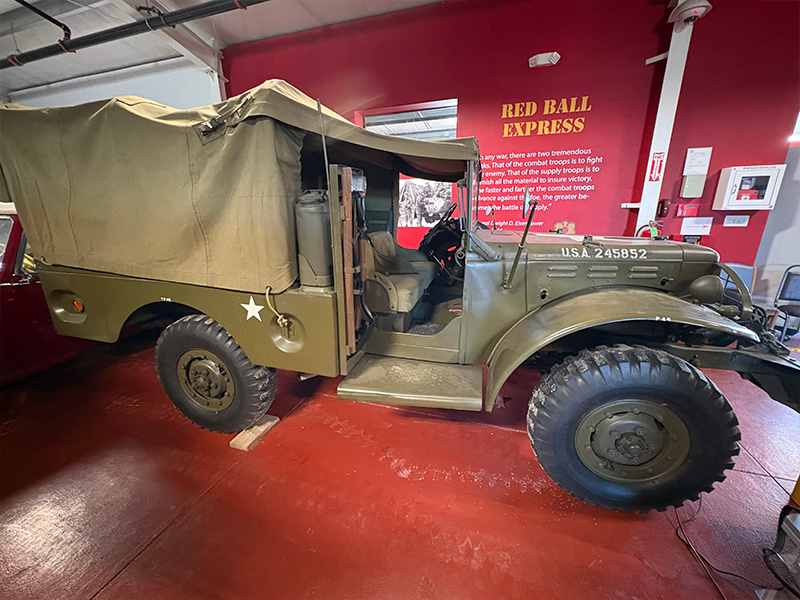
Specifications
| GENERAL DATA | |||
|---|---|---|---|
| Crew (operating) | 2 | ||
| Weight | Net | 5,250 lbs | |
| Payload | 1,500 lbs | ||
| Length | 166 7/8 | inches | |
| Width | 82 3/4 | inches | |
| Height | 81 7/8 | inches | |
| Engine | Dodge | T-124 | |
| Horsepower | 92 hp | 69 kW | |
| Transmission | 4 speed | 1 range | |
| Suspension | Live beam | Leaf Springs | |
| Fuel Capacity | 30 | US Gallons | |
| Operational Range | 240 miles | 3687 km | |
| Maximum Speed | 55 mph | 89 km/h | |
History
The Dodge WC series, nicknamed "Beeps", and at first (from 1940–1942), nicknamed jeeps,is a prolific range of light 4WD and medium 6WD military utility trucks, produced by Chrysler under the Dodge and Fargo marques during World War II. Together with the later 1⁄4‑ton jeeps produced by Willys and Ford, the Dodge 1⁄2‑ton G-505 and 3⁄4‑ton G-502 trucks made up nearly all of the light 4WD trucks supplied to the U.S. military in WW II – with Dodge contributing some 337,500 4WD units (over half as many as the 1⁄4‑ton jeeps).
Contrary to the versatility of the highly standardized 1⁄4‑ton jeeps, which was mostly achieved through field modification, the Dodge WC‑series came in many different, purpose-built, but mechanically uniform variants from the factory, much akin to the later family of High Mobility Multipurpose Wheeled Vehicles. The WC series evolved out of, and was part of a more extended family of trucks, with great mechanical parts commonality, that included open- and closed-cab cargo, troops and weapons carriers, (radio) command, and reconnaissance cars, ambulances, carry-alls, panel vans, and mobile telephone installation and (emergency) field workshop trucks.
Throughout the war, Dodge was the U.S. Army's sole producer of 3⁄4‑ton trucks, and built a total of 255,193 of these, across all variants, from April 1942 to August 1945. Standard vehicles in the 3⁄4‑ton 4x4 class were the WC-51 / WC-52 Weapons Carrier, WC-56 /-57 /-58 (Radio) Command Reconnaissance, WC-53 Carry‑all, and the WC-54 Ambulance. In the mass-produced cargo/troop and command trucks, the WC-52 and WC-57 are identical to the WC-51 and WC-56, but have a longer frame, extending further forward to the protruding front bumper with front-mounted winch.
After the U.S. Army reorganized from using eight-troop rifle squads to twelve-men squads, a whole squad could no longer be carried as a unit in a single 3⁄4‑ton, 4x4, WC-51 or WC-52 truck. At the direction of Major General Courtney Hodges, Chief of Infantry, these G-502 troop- and weapons-carriers were therefore stretched in 1943, with an additional driven rear axle, to derive a 48 in (1.22 m) longer 6-wheel drive, 11⁄2‑ton trucks.


Proud To Be Home of the
