

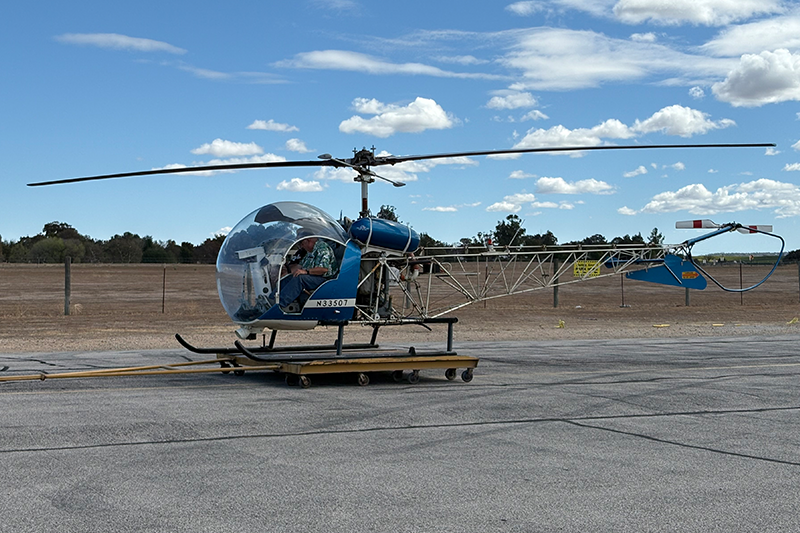
Specifications
| Manufacturer: | Bell | |
|---|---|---|
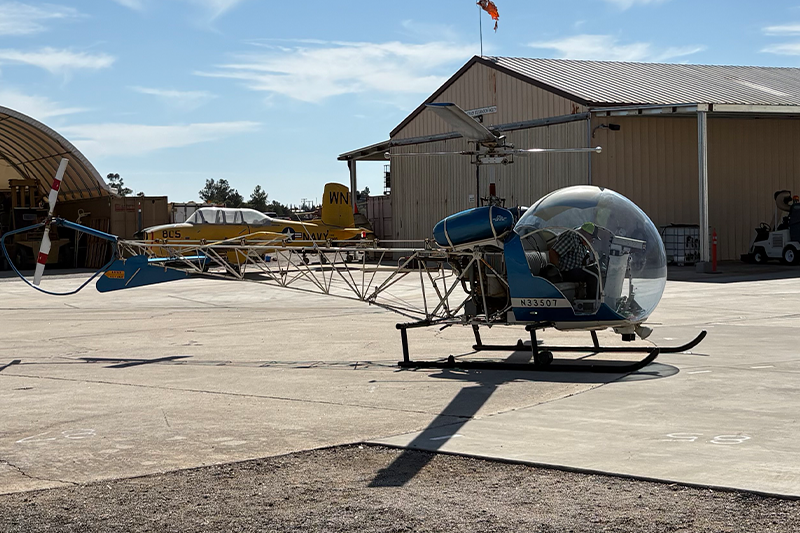
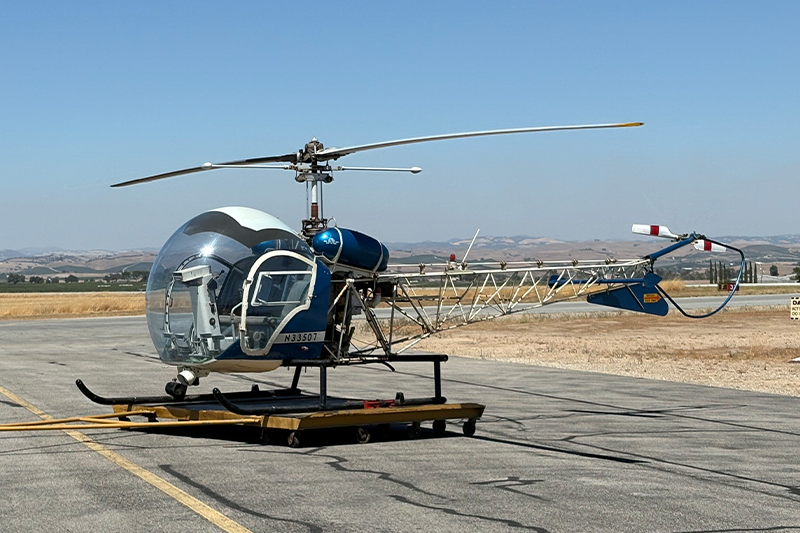
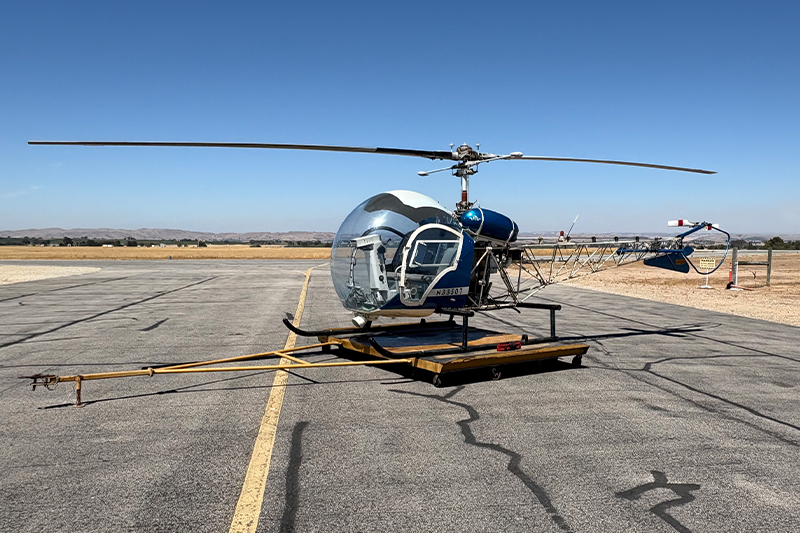
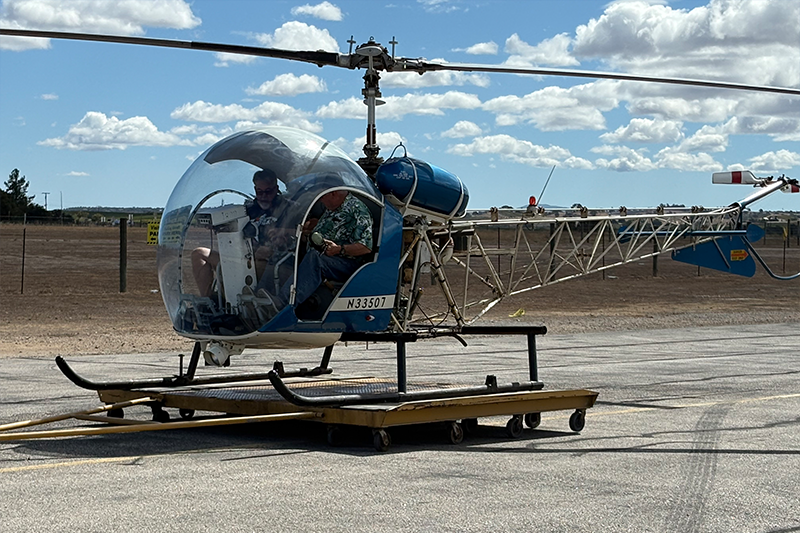
| Year/Model: | 1952 H 13G Sioux (Redisgnated to OH-13G in 1962 | |
| S/N: | 52-7861 | |
| Tail Number: | N33507 | |
| Power Plant: | 1x 260 hp Lycoming VO-435 piston engine | |
| Main Rotor Diameter: | 35 ft 1.5 in | |
| Length: | 41 feet 5 inch | |
| Height: | 9 feet 5 inches | |
| Empty Weight: | 5,215 pounds (MTOW) | |
| Max. Takeoff Weight: | 12,499 lb | |
| Maximum Speed: | 86 mph | |
| Cruise Speed: | 70 knots | |
| Range: | 212 miles | |
| Service Ceiling: | 3,600 ft (dependent on factors such as weight, air temp, etc. | |
| Rate of Climb: | 1,755 ft/min | |
| Armament: | various including 7.62mm machine guns, 2.75 inch rocket pods | |
| Crew: | 1 - 4 | |
| Status: | Static Display (currently under restoration) | |
| Owner: | Estrella Warbird Museum | |
| *Note: | This helicoter was previously painted showing serial/tail # 65-26997 which was found to be incorrect. It is currently identified with the correct serial/tail number. | |
In Flight
History
The Bell H-13 Sioux is an American single-engine light helicopter built and produced by Bell Helicopter for the military and licence-produced by Westland Aircraft for the British military as the Sioux AH.1 and HT.2. It was the first helicopter to be certified for civil use.
In 1947, the United States Army Air Forces (later the United States Air Force) ordered the improved Bell Model 47A. Most were designated YR-13 and three winterized versions were designated YR-13A. The United States Army first ordered Bell 47s in 1948 under the designation H-13. These would later receive the name "Sioux".
The H-13 was one of the principal helicopters used by the U.S. Army during the Korean War, with the H-13D variant being the most prevalent. During the war it was used in a wide variety of roles including observation, reconnaissance, and medevac. From its role in medevac flights, it gained the nickname "Angel of Mercy". It was also used as an observation helicopter early in the Vietnam War, before being replaced by the Hughes OH-6 Cayuse in 1966.
The Sioux is a single-engine, single-rotor, three-seat observation and basic training helicopter. In 1953, the Bell 47G design was introduced. It can be recognized by the full "soap bubble" canopy (as its designer Arthur M. Young termed it), exposed welded-tube tail boom, saddle fuel tanks and skid landing gear. In its UH-13J version, based on the Bell 47J, it had a metal-clad tail boom and fuselage and an enclosed cockpit and cabin.
The H-13 and its military variants were often equipped with medical evacuation panniers, one to each skid, with an acrylic glass shield to protect the patient from wind. Anyone who has ever watched the hit TV series, MASH, would easily recognize the H-13 as it appeared in each episode.
The development of the Sioux was helped greatly by Bell's implementation of a short weighted gyro-stabilizer bar at 90° beneath and to the main rotor. It had streamlined counterweights at both tips and was linked so it determined which plane the rotor was in and kept it horizontal.[8] The stabilizer, which was connected to the cyclic pitch control, acted as a hinged flywheel using gyroscopic inertia to keep the rotor blades in plane and independent of fuselage movement due to wind. It ensured that the system had enough inertia due to flight as well, so autorotation would function in case of engine failure.
The OH-13G is a three-seater based on commercial model 47-G. It also introduced a small elevator on the tailboom. 265 delivered to US Army.


Proud To Be Home of the
